Why does traceability protect the restaurateur?
In foodservice, risk is never zero: an ingredient, a supplier or a logistics link can become the subject of an alert. The real question is not only "how do I avoid it" but "how do I react fast and accurately". That is exactly what traceability delivers.
Without it, a suspicion about a product forces you to pull everything, lose stock and interrupt service. With fine-grained traceability, you trace back to the exact lot, identify which orders are affected and contain the incident. The restaurateur limits the damage, protects customers and demonstrates due diligence.
It is also legal protection: during an inspection or dispute, being able to document origin, controls and the cold chain is the difference between liability you simply absorb and good faith you can prove.
« Our goal is simple: if a question arises about a delivery, we should trace back to the exact potato lot in minutes, not days. That is what traceability that truly protects the customer looks like. »
What does the notion of a lot actually mean?
A lot groups products made under homogeneous conditions: same raw material, same production window, same parameters. It is the basic unit of all modern food safety, because it lets you reason in coherent sets rather than product by product.
Traceability works in two directions. Upstream traceability goes from the finished product back to its ingredients and suppliers (where did this potato come from?). Downstream traceability starts from a lot to find every customer who received it (who got this lot?). Mastering both means you can target a recall instead of blocking everything.
How does Nouryla trace Kroustis fries and big bags?
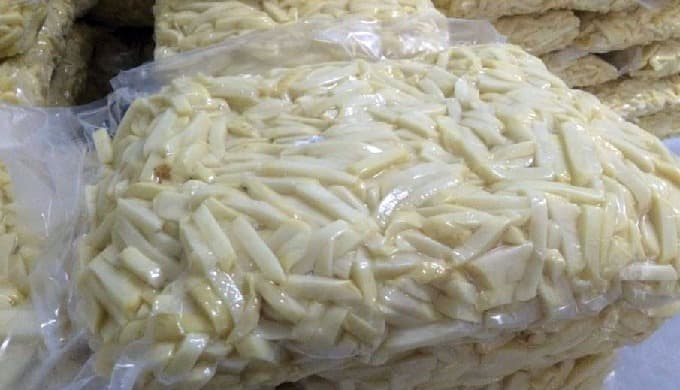
Nouryla's traceability is designed to be actionable, not merely archived. Kroustis fries, fresh and vacuum-sealed (never frozen), are packed in 10 kg bags, and every step is linked within the CorLink ERP.
In practice, the information travels with the product all the way to the customer's kitchen. If a question arises about a delivery, simply starting from the delivery note allows you to trace back to the potato lot, the big bag and the production conditions.
The anchor points of Kroustis traceability:
- Delivery note = exact potato lot: each fries delivery note carries the precise lot number of the raw material used.
- Big bag with unique ID: each 10 kg vacuum-sealed bag has its own identifier, tracked in the system.
- CorLink ERP: centralizes the links between raw material, production, packaging and delivery.
- Controlled sourcing: HVE potatoes, with priority given to supply within 250 km of Paris.
- Documented cold chain: 0-4 °C storage and a refrigerated fleet for next-day (J+1) delivery.
HACCP, liquid eggs and controls: the daily barriers
HACCP (Hazard Analysis and Critical Control Points) is not a document you file away: it is a method that identifies hazards (microbiological, physical, chemical) and places barriers at critical points. At Nouryla, HACCP is applied and structures production controls.
The choice of liquid eggs for Noblépis burger buns illustrates this preventive logic. Liquid eggs, pasteurized and standardized, reduce microbiological risk and variability compared with shell eggs cracked by hand. It is a food-safety decision as much as an industrial-consistency one.
Added to this are controls, monitored production parameters and a water-recycling unit for production water, consistent with an overall quality and environmental approach.
Where does Nouryla stand on ISO 22000?
The ISO 22000 trajectory is in progress: the certification is not yet obtained, and we say so plainly. The ISO 22000 standard governs food safety management, articulating HACCP, prerequisite programs and continuous improvement.
Committing to this approach, even before certification, has an immediate benefit: it forces you to formalize procedures, document controls and make traceability reliable. The restaurateur benefits right now, through an already rigorous information chain. Nouryla places ISO 22000 within a broader trajectory (ISO 9001 and 14001 also in progress), in the service of quality and responsibility.
What habits should restaurateurs adopt?
Food safety is a shared chain: it does not stop at the factory door. On the establishment side, a few simple habits significantly strengthen protection and make any potential investigation easier.
The goal is not to burden daily operations, but to keep a usable record. Keeping delivery notes, respecting use-by dates and maintaining the cold chain is already enough to close the traceability loop right down to the plate.
Best practices to build in:
- Keep delivery notes: they link your dishes to the exact potato lot if ever needed.
- Respect use-by dates: Kroustis fries 7 days (MAP project targeting 12-15 days), Noblépis buns 3 days.
- Maintain the cold chain on receipt: check temperature at delivery and store at 0-4 °C.
- Follow stock rotation (first in, first out) to avoid any expiry.
- Report any anomaly quickly: the earlier the alert, the more efficient the lot targeting.