Why choose fresh fries over frozen?
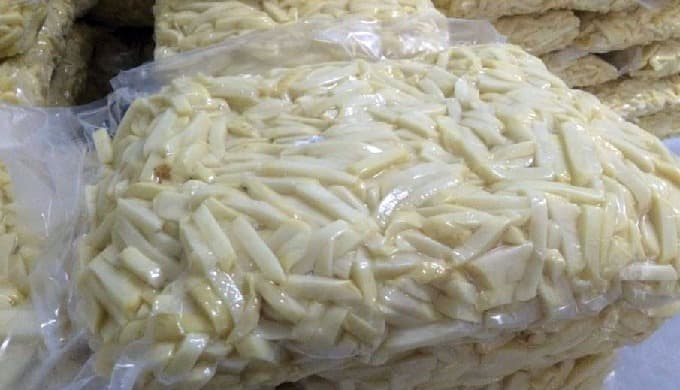
The main difference between fresh and frozen fries comes down to the raw material and how it is processed. Fresh vacuum-sealed fries are made from peeled, sized and cut potatoes, then packed without any freezing. The result: preserved potato flesh, a crisp finish when cooked, and a taste closer to homemade, without the sometimes mealy feel of certain frozen industrial products.
For a restaurateur, this choice is also about positioning. Offering fresh fries means claiming higher quality on the menu, justifying a selling price, and building loyalty among product-conscious diners. This is the central argument of Kroustis, Nouryla's fresh vacuum-sealed fry, available in two references: La Rustik (with skin) and L'Authentik (without skin).
« A fresh vacuum-sealed fry isn't judged by taste alone: it's judged by a consistent cut, the lot traced on the delivery note, and the truck that arrives on time before service. »
What are the 7 criteria for choosing a fresh fries supplier?
Before signing with a supplier, run each candidate through these concrete criteria. They determine both the quality on the plate and how smoothly your daily operation runs.
The evaluation checklist to apply:
- Genuine freshness: fresh vacuum-sealed fries, never frozen, for superior texture and taste.
- Consistent cut: a steady cut (such as 11x11) ensures even cooking and predictable yield.
- Transparent shelf life: a short, clearly displayed date reflects the product's freshness.
- Suitable packaging: 10 kg vacuum-sealed bags, easy to store in cold rooms and portion at service.
- Reliable delivery: the ability to deliver next-day in your area, with a clear order cut-off.
- Traceability: potato lot number on the delivery note and a unique identifier per bag.
- Consistency: steady quality, cut and availability all year round, with no stockouts.
Cut, packaging and shelf life: what should you check exactly?
The cut directly drives cooking. A fry that is too thin burns; one that is too thick stays soft in the centre. A consistent cut, like the 11x11 of Kroustis, ensures controlled frying and an identical result from one service to the next. Always ask your supplier for the exact cut and how consistent it is from lot to lot.
On packaging, the 10 kg vacuum-sealed bag is a format designed for foodservice: it stores easily in a cold room at 0-4 °C, limits oxidation and portions cleanly at service. As for shelf life, it should be short and legible. Kroustis carries a 7-day shelf life, with a modified-atmosphere (MAP) project intended to extend it to 12-15 days, which will make stock management easier without sacrificing any freshness.
Does next-day delivery in the Paris region change the game?
Yes, logistics is often the criterion that separates two suppliers of equivalent product quality. Fresh fries are only worthwhile if they arrive fast and within the right window. Nouryla applies a 5 p.m. order cut-off for next-day dawn delivery in the Île-de-France region, handled by its own fleet of five refrigerated vehicles under 3.5 t, and by STEF for national deliveries.
In practice, you order in the evening and are delivered the next morning, before service. The cold chain is maintained at 0-4 °C end to end. Before committing, verify the area covered, the reliability of the delivery windows, and how orders are placed: at Nouryla, 70% of orders go through the OrderLion app, which streamlines reordering and reduces input errors.
Traceability and consistency: the marks of a serious partner
Traceability is not an administrative detail: it is your protection during a health inspection or when a customer asks a question. A serious supplier must be able to link every bag delivered to a specific potato lot. At Nouryla, the CorLink ERP ensures this traceability: each fries delivery note carries the exact potato lot number, and each big bag has a unique identifier.
Consistency, for its part, is measured over time. A good supplier delivers the same quality, the same cut and the same availability all year round. Nouryla applies the HACCP method, favours HVE potatoes sourced as a priority within 250 km of Paris, and frames its production within an ISO 9001, 14001 and 22000 certification trajectory (process in progress). A production-water recycling unit completes this responsible approach.
How should you test a supplier before committing?
Before any contract, run a real-world trial. Order a volume representative of one week of service, test the cooking of your references on your own equipment, and measure the actual yield after frying. Taste the fry exactly as your customers will receive it, and have your kitchen team test it blind.
Then validate the logistics: place a real order, check that the next-day window is respected, the condition of the goods on receipt and the clarity of the delivery note (lot number, shelf life, cut). A supplier able to offer two complementary references, such as La Rustik with skin and L'Authentik without skin, lets you tailor your offer to your menu. It is this combination of product quality, reliable logistics and traceability that defines the right fresh-fries partner over the long term.